Quick answer: Sometimes, yes. Losing weight can make your face look fresher by reducing puffiness and revealing sharper cheekbones and a more defined jawline. But it can just as easily do the opposite. Lose weight too quickly, or lose a large amount, and your face can end up looking gaunt, saggy and older than before — a trade-off now widely known as “Ozempic face.” Which way it goes for you depends mainly on your age, your skin’s elasticity, and how fast you lose the weight.
In this guide
- The science: how weight loss changes your face
- Can losing weight make you look older? (“Ozempic face” explained)
- What determines which way it goes for you
- The under-eye surprise nobody warns you about
- How to lose weight without ageing your face
- A note on weight-loss injections and your face
- Frequently asked questions
It’s one of the most-searched beauty questions in the UK right now, and it’s easy to see why. Interest has climbed alongside the rise of weight-loss jabs like Mounjaro and Wegovy, and social media is full of before-and-afters that tell two completely different stories — some people look years younger after losing weight, others look years older.
Both are true. Weight loss doesn’t have one single effect on how old you look — it can go either way, and sometimes both at once (a fresher complexion, but a more hollow-looking face). This guide walks through why that happens, what actually determines the outcome, and how to tip the odds in your favour.
The science: how weight loss changes your face
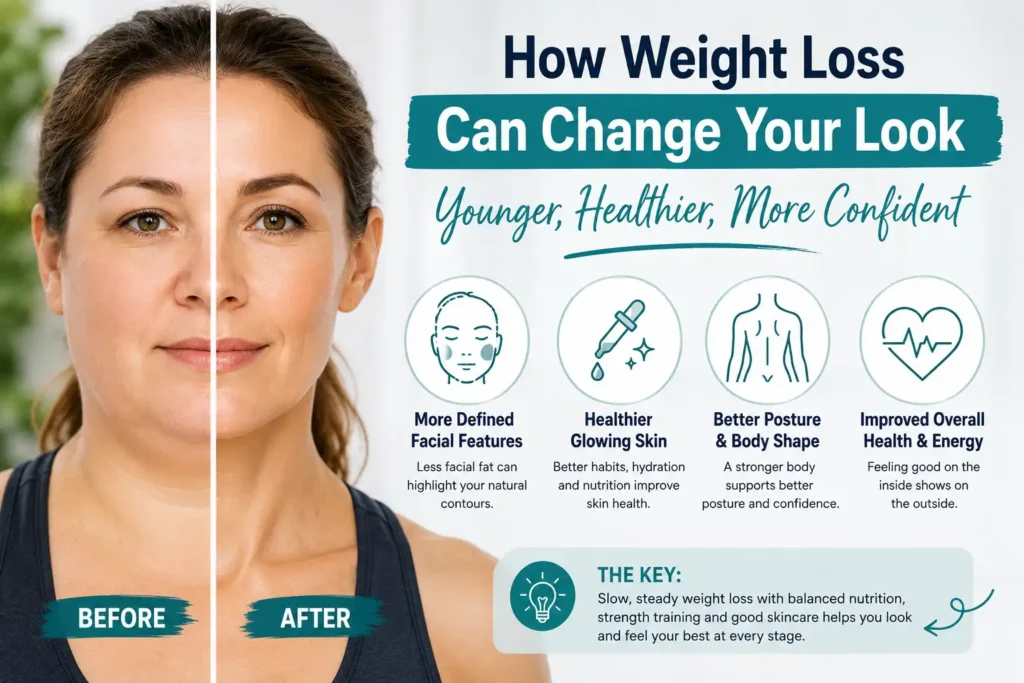
Your face isn’t just skin stretched over bone. It has its own layer of fat, including a small pad in each cheek called the buccal fat pad, plus a thin layer of fat just beneath the skin’s surface. This fat cushions your features, softens the transitions between your cheeks, eyes and jaw, and gives your face its fullness.
When you lose weight, your body doesn’t only take fat from your stomach or thighs — it takes it from your face too, and the face is often one of the first places it shows, because facial fat sits close to the surface and responds quickly to a calorie deficit.
What happens next comes down to two competing effects:
- Less puffiness. Carrying extra weight is often linked with fluid retention and low-grade inflammation, both of which can make the face look swollen. Losing weight can ease this, revealing a more defined, refreshed appearance.
- Less volume. That same fat was also plumping out fine lines and giving your face its youthful cushioning. Losing it can unmask wrinkles that were previously hidden, and cause the skin to sag where it’s lost some of its natural elasticity.
Which effect wins out largely comes down to collagen and elastin — the structural proteins that let skin “spring back” after it stretches. Younger skin has plenty of both, so it tends to retract fairly well. Skin over about 35–40 naturally has less of each, so the same amount of weight loss is more likely to leave visible slack.
Can losing weight make you look older?
Yes — and dermatologists have a name for it. “Ozempic face” describes the gaunt, sunken, more-wrinkled look that can follow rapid or significant weight loss. The term was coined in 2023 by a New York dermatologist who noticed the pattern in patients using GLP-1 weight-loss medications, and it’s since become shorthand for the phenomenon generally — even though, importantly, it isn’t limited to people taking Ozempic, Wegovy or Mounjaro. Any fast weight loss, whether from a crash diet, illness, extreme exercise or surgery, can cause the same effect.
Cleveland Clinic describes the look as a combination of gauntness, sunken cheeks, new wrinkles and loose skin across the face and neck. The underlying cause is simple: when fat disappears faster than your skin can tighten around the smaller structure underneath, the skin sags instead of snapping back.
The scale of the effect is bigger than most people expect. One 2025 imaging study, published in Otolaryngology–Head and Neck Surgery, estimated that for roughly every 22lb (10kg) lost, midfacial volume drops by around 7%. Researchers are also investigating whether GLP-1 medications might directly affect the skin cells responsible for producing collagen — which could compound volume loss with a genuine drop in skin quality, though this research is still ongoing.
What is “Ozempic face”, exactly?
In short: it’s facial ageing caused by losing fat and volume faster than your skin can adapt. It isn’t a side effect of any specific drug — it’s a side effect of speed. The faster and larger the weight loss, the more likely your skin is to sag rather than tighten, particularly if you’re over 35, have a history of sun exposure, or smoke, all of which reduce skin elasticity beforehand.
What determines which way it goes for you
| Factor | Why it matters |
|---|---|
| Your age | Collagen and elastin naturally decline from your mid-30s onwards, so older skin retracts less easily after fat loss. |
| How fast you lose weight | Gradual loss gives skin time to adjust. Rapid loss — crash diets, high-dose GLP-1 medication, or bariatric surgery — often outpaces your skin’s ability to tighten. |
| How much you lose | Small or moderate weight loss rarely causes visible sagging. Losing a large percentage of your body weight makes facial volume loss far more noticeable. |
| Skin condition beforehand | Sun damage and smoking break down collagen and elastin over time, so already sun-damaged skin has less “spring” to begin with. |
| Genetics | Some people’s skin is simply more elastic than others’, independent of age or lifestyle. |
| Muscle mass | Losing muscle alongside fat — common with very low-calorie diets — removes extra structural support from the face on top of the fat loss. |
No single factor decides the outcome alone; it’s the combination that matters. A 25-year-old with good skin elasticity who loses weight gradually is unlikely to develop “Ozempic face.” A 55-year-old who loses a large amount of weight quickly is far more likely to.
The under-eye surprise nobody warns you about
Here’s something most people don’t expect: losing weight can sometimes make under-eye bags look worse, not better.
It seems counterintuitive, because puffiness caused by fluid retention, salt intake or poor sleep genuinely does improve with weight loss. But there’s a separate cause of under-eye bags — the fat pads that naturally sit beneath your eyes — and weight loss can make these more visible rather than less.
Here’s why: fat in your cheeks and midface normally helps blend the transition between your lower eyelid and your cheek, softening the border between the two. When that cushioning fat is lost, the border becomes more obvious, and the under-eye fat pad — which was always there — suddenly stands out. Surgeons increasingly see this in people who’ve lost significant weight through GLP-1 medications, and typically address it by restoring volume to the cheek rather than treating the under-eye area on its own.
If you’ve lost weight and feel like your eye area looks more tired rather than less, this is very likely why — and it isn’t something you did wrong.
How to lose weight without ageing your face
You can’t fully control how your skin responds to weight loss — genetics and age play a big role. But there’s a lot within your control that meaningfully improves your odds of keeping a fresh, youthful look.
Lose weight gradually. The NHS recommends losing weight at a safe, sustainable rate of 0.5–1kg (1–2lb) a week. This isn’t just about avoiding regain — it’s genuinely one of the biggest factors within your control for protecting your skin, because it gives collagen and elastin time to adjust as your face gets smaller.
Prioritise protein. Try to include a source of protein at most meals. Protein supplies the amino acids your body uses to build collagen and elastin, and it also helps you retain muscle mass while losing fat — both of which support your skin from underneath.
Get enough vitamin C. Vitamin C is essential for collagen production; without it, your body can’t make new collagen effectively. Citrus fruit, berries, peppers and leafy greens are all good sources.
Stay hydrated. Well-hydrated skin is more elastic and plump. Dehydrated skin looks slacker and emphasises fine lines.
Keep strength training. Resistance exercise helps preserve muscle mass during weight loss, rather than losing muscle alongside fat, and supports circulation, which benefits skin quality generally.
Don’t skip sun protection. UV exposure breaks down collagen and elastin over time, so sun damage compounds any volume loss from weight loss. Daily SPF is one of the simplest ways to protect the skin elasticity you have left — genuinely useful advice even under the UK’s grey skies, since UV levels matter more than visible sunshine.
Mind your blood sugar. Chronically high blood sugar damages collagen and elastin through a process called glycation, where excess sugar binds to these proteins and stiffens them — a separate ageing pathway from fat loss entirely. A weight-loss diet that’s naturally lower in refined sugar may help protect your skin through this route too, on top of the fat loss itself.
Try face yoga — with modest expectations. A small 2018 study published in JAMA Dermatology found that women aged 40–65 who did 20 weeks of consistent facial exercises saw modest improvements in cheek fullness. It’s not a miracle fix and the evidence base is still thin, but it’s low-risk and may help at the margins alongside everything else here.
Know when to see a professional. If you’ve lost a significant amount of weight and have noticeable sagging, a dermatologist can talk you through options like dermal fillers, radiofrequency skin tightening or, for more advanced cases, surgical procedures. There’s no need to simply live with changes that bother you.
A note on weight-loss injections and your face
This question has become especially relevant in the UK over the past couple of years. According to research from UCL published in BMC Medicine, an estimated 1.6 million UK adults used a GLP-1 medication such as Mounjaro or Wegovy for weight loss in the year to early 2025 — with a further 3.3 million saying they’d like to start within the next year.
These medications are effective specifically because they produce faster, larger weight loss than most people achieve through diet alone — which is exactly the combination that raises the risk of facial volume loss. That doesn’t mean facial changes are inevitable if you’re using one, but it does mean they’re worth planning for rather than being caught out by.
If you’re using or considering a GLP-1 medication, it’s worth raising your skin and facial appearance with your prescriber as part of the conversation, alongside the pace of weight loss and your protein intake. The British Heart Foundation has a helpful, impartial overview of how these medications work if you’re weighing up your options.
Frequently asked questions
The bottom line
Losing weight does not have one guaranteed effect on how old you look. It can genuinely go either way, and many deciding factors remain within your control. Losing weight gradually, eating enough protein, staying hydrated, protecting your skin from sunlight and maintaining muscle can improve your chances of looking fresher rather than older. Tools such as the James Smith calorie calculator may help you estimate a suitable daily calorie target, but the result should be treated as a general starting point.
It’s also worth saying plainly: there’s no obligation to lose weight for the sake of your appearance. Most people who choose to lose weight are doing it for health reasons, and that’s a good enough reason on its own. If facial ageing is a concern for you — whether you’re already losing weight or thinking about it — it’s a completely reasonable thing to raise with your GP, a dietitian or a dermatologist, who can help you plan an approach that supports your skin as well as your health.
This article is for general information only and isn’t a substitute for personalised medical advice. If you’re planning significant weight loss or considering a weight-loss medication, speak to your GP or a registered dietitian first.